

Happy Friday and Happy Solstice This Weekend!
I am fully in summer mode in the studio now, which only means earlier morning walks and fans running as I work! This morning my walk was in the rain we are finally receiving here in Raleigh, and it was glorious. Everything looked so relieved and quenched, though we still need more rain to even begin to alleviate the dry weather we have been experiencing all spring. The studio is such a cozy place on rainy days, and I hope this rain lasts all day!
I thought a blog about vocabulary might be helpful, but I think it is going to take more than one blog to cover the special language we use as quilters/sewists/artisans. This week I thought I would explain the definition of a quilt and discuss how it is different and similar to a blanket. Some quilters really take offense at their quilts being called a blanket, but I don’t mind. I know what people mean!
For this discussion, I went back to my favorite source for words, The Oxford English Dictionary, and yes I own a complete set, which means I need a magnifying glass to read it, and yes, I derive a great deal of pleasure from looking up words. The OED, as it is known, is a singular piece of ongoing scholarship, and if you have the time to read about it, you should. The OED tracks words from their earliest usage right up to the present day…if you have a brand new set, so intrepid logophiles can see how a word has been used and changed over time. For instance, the word “wood” used to mean crazy…as in Chaucer saying someone behaved, “as if he wer wood” in Middle English. Yes, I read Chaucer in Middle English and Beowulf in Anglo Saxon…I am a literary medievalist at heart!
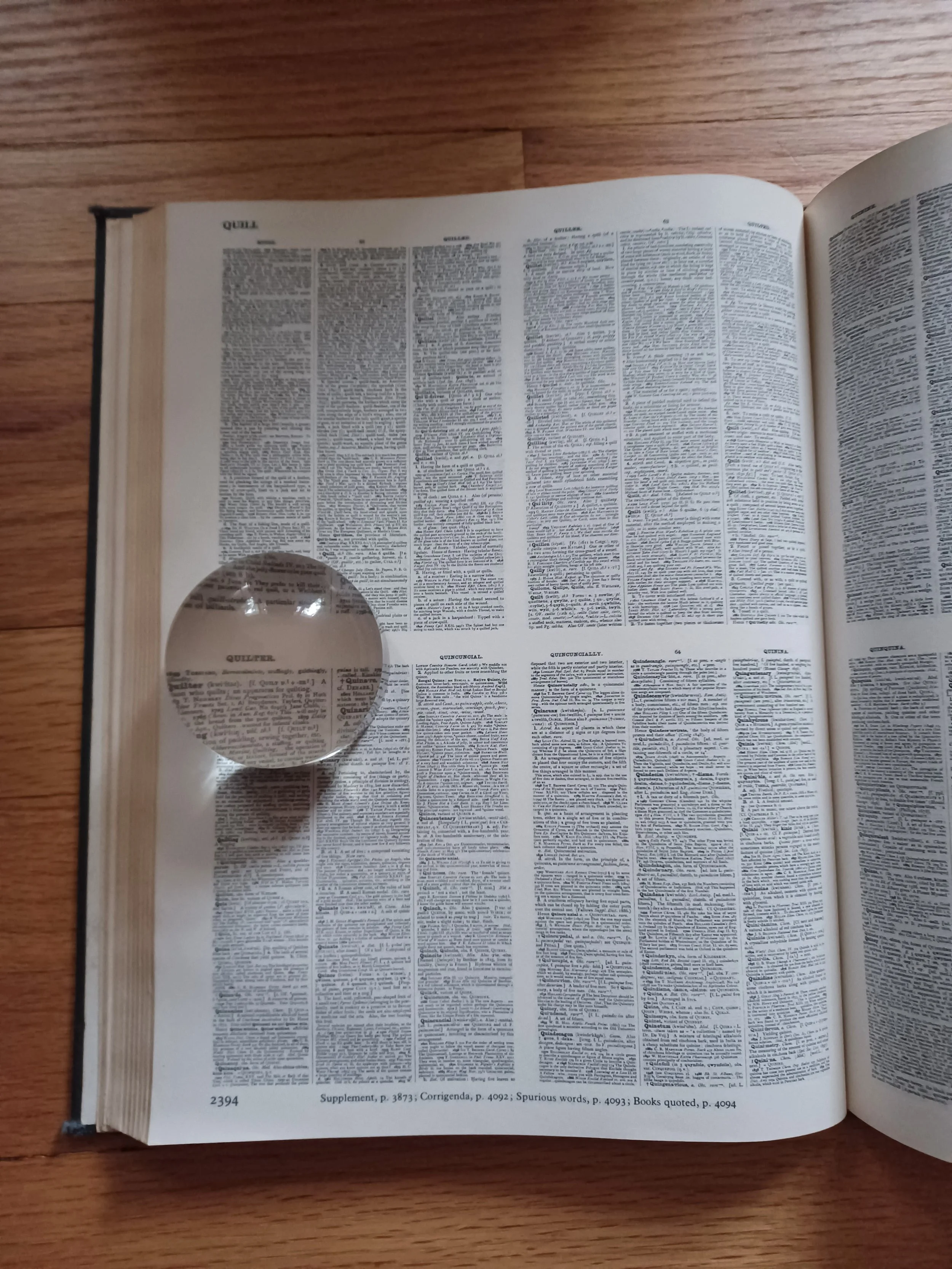
The picture shows one volume of the OED open to the word quilter, and my little flat globe magnifier I use is sitting on top of the word “quilter.” In college when I was taking Chaucer and Old English classes, I would spend hours in the floor of DH Hill in front of NCSU’s full set of the OED.
Upon looking up “Blanket” and “Quilt” in the OED I found so many fun similarities; both are from Old French and have been in use for centuries and they can both be nouns and verbs. English speakers likely saw them both introduced after William the Conquerer won The Battle of Hastings in 1066, which is the sign post for the shift in English that we see from Old English to Middle English. That French influence softened up the harder Anglo Saxon and gave us so many good words!
Blanket (Old French: blankete. French: blanquette) as a noun is a large oblong sheet (one layer) often of soft loose wool used for retaining heat. As a verb the word means to cover.
Quilt (Old French Coute to Coulte. Becoming Coulte and Qwylte in Middle English) as a noun is layered cloth, often decorative, fastened and used as the outer covering on a bed. We have also called quilts Counterpanes, which are outer coverings for beds, woven, raised, quilted, made mostly of patchwork; coverlet. As a verb the word Quilt means the action of fastening the layers of cloth together.
So the difference between a Blanket and a Quilt becomes very obvious, right? A Blanket is one piece of fabric, wool, cotton, linen, but it is only one layer, and it blankets your bed. A Quilt is layers of fabric, contemporarily three layers: top, batting, and back. These layers are then Quilted or fastened with stitches. and the tops of quilts are often made from patchwork, making them historically more decorative. Though with all of our modern printing methods blankets can be highly decorative themselves.
Quilts, as you can see, do require a lot more work than a blanket, so I can see why quilters get upset when their hours and hours of labor is called a blanket! I make quilts, but I understand what people mean when they contact me asking for a blanket…I know they really mean a quilt, and by the end of the process, I think my clients really understand the difference.
Sending Quilty love,
Ginger
Currently Reading: The OED of course, and I am still working on “You Can’t go Home Again,” while picking up Middlemarch…I want to read Bleak House, too…Yes, Dickens is calling to me again. My brain loves his descriptions. And writing this blog has wetted my appetite for some Chaucer, too. What are you reading? Read what you love!
Unbiased news and information is more important than ever. NPR is an excellent source. I hope you are kind to everyone.
