

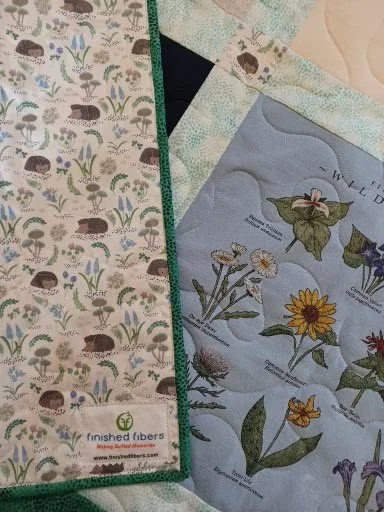
The backs of quilts, the third layer of the quilt sandwich, are traditionally one fabric made or cut large enough to fit the needs of the quilt top. The back should be larger than the quilt top because the actual quilting still has to done. Since I use my APQS Lenni to longarm my quilts, I add six inches to both measurements of the top of the quilt. The leaders and the quilting process often makes the back “creep” or inch a little bit, so if the back is exactly the same size as the top, when you get to the bottom of the quilt, you will find the back shorter than the quilt top. No one wants that to happen! So for a 66” x 66” quilt top, I will make the back 72” x 72.” Anyone getting quilts professionally quilted should make their backs with the same formula. Even when I hand quilt or use my domestic machine to quilt, I make the back larger, so that the quilt can be trimmed and finished appropriately.
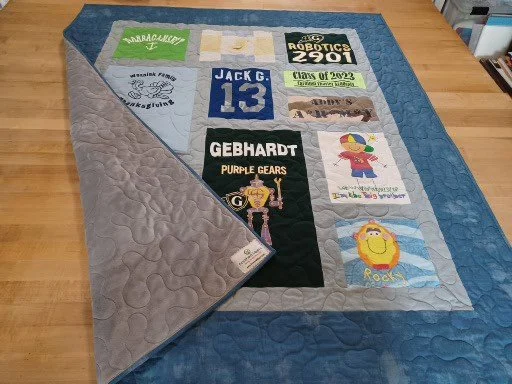
The back of a quilt can also be a different fabric type from the front. Flannel and Cuddle or Minky backs are popular, making the back so soft and cuddly. This Custom T-Shirt quilt has a gray Cuddle fabric. The Cuddle fabrics also have such a pretty loft, showing off the beautiful quilting stitches and design.
108” fabrics are perfect backs because they are 108” in length and can be torn to fit the needed width, thus making the back one solid piece of fabric with no seam. No sewing or pattern matching need happen in this instance. 40”-45” fabric is pieced to create the back, usually with a horizontal seam(s), and pattern matching will need to happen on larger print fabrics.
Backs can also be more than just one fabric. some quilters like to use leftover fabrics, or scraps or remnants to create a scrappy back, which we like to call a “party in the back!” Pieced backs can be fun and useful in using fabrics, and they can be helpful in a memory quilt that has a piece or pieces that don’t fit on the front. Of course a quilt can be double-sided, too, meaning, either side of the quilt can be the “top” and both sides are decorative and pieced.
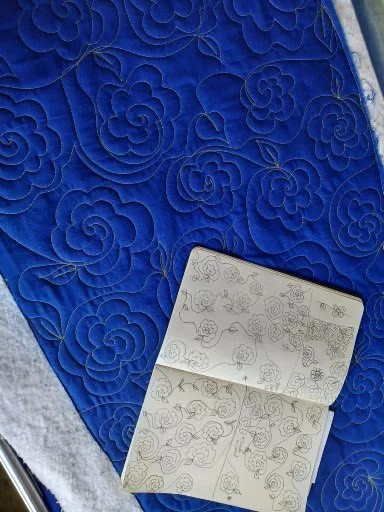
Practice quilting on blue fabric with my quilt sketch book on top of it. You can see here how quilting can really be seen on solid or one fabric without pieces.
Backs may seem to be less important than the top layer of the quilt, but the back is seen, too, and coordinating fabrics and having a lovely back makes the whole piece more beautiful. Plus, the back of the quilt, especially with single fabric backs, often shows off the quilting from the front better! The back is also the home of the quilt label…offering a place for a message and a place for the quilter’s information. We should all label our quilts!
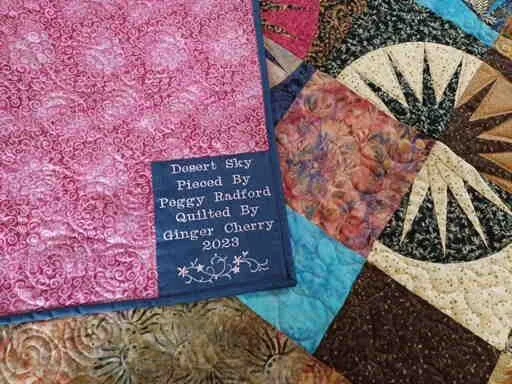
The back of this quilt has a beautiful hot pink blender and a lovely navy label. I love the embroidery here, which adds to the sweet recognition of the piecer and the quilter.
A quilt is so special because it is layered and nuanced in so many different ways beyond the three layers of the quilt sandwich, and memory and T-Shirt quilts are especially evocative. What layers would make up your quilt?
Sending Quilting Love,
Ginger
Reading Now: I finished another Louise Penny mystery, and I am well into Middlemarch now. I am also reading the third novel of the Lockwood & Company series…a ghosty, fun world. I might pick up a nonfiction to add to the mix, but I am not sure which one yet….Margaret Atwood’s Memoir? Mozart’s Starling? Something by Annie Albers? Some literary criticism? I have lovely options…What are you reading?
Always be kind. Listen to NPR, and avoid biased news sources. My little studio is a small haven; I hope you have a haven, too.
